Max heart rate formula: 208 − 0.7 × age fits the data better than 220 − age
· updated · 5 min read
The short answer
The best-supported formula for maximum heart rate is 208 − 0.7 × age, from a 2001 meta-analysis of 351 studies and 18,712 people. It agrees with 220 − age at 40, gives a slightly lower figure before 40 and a higher one after: at 70 it gives 159 beats a minute, against 150. It held for men and women and didn’t differ by activity level. It’s a population average, so your own maximum may be higher or lower.
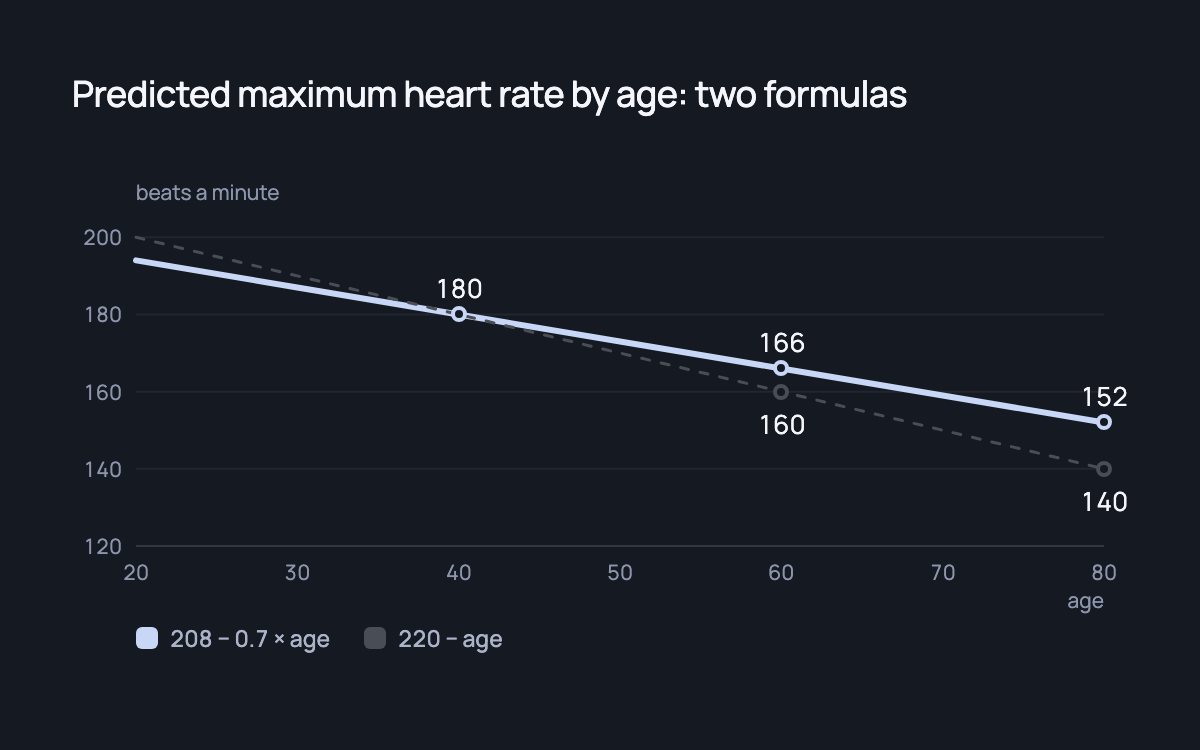
The two formulas, age by age
Most people know the rule 220 − age. The formula with stronger evidence behind it is 208 − 0.7 × age. Both give 180 at 40, and the gap between them widens with each decade away from 40.
- At 20: 200 by 220 − age, 194 by 208 − 0.7 × age
- At 30: 190 and 187
- At 40: 180 and 180
- At 50: 170 and 173
- At 60: 160 and 166
- At 70: 150 and 159
- At 80: 140 and 152
Below 40 the older rule gives a figure up to 6 beats higher. Above 40 it gives a lower one, by 3 beats at 50 and 12 at 80. For anyone past middle age, then, 220 − age puts maximum heart rate below the better-supported estimate, and every training zone calculated as a percentage of it comes out lower too.
Sources: Tanaka H 2001
Where 208 − 0.7 × age comes from
The formula comes from a 2001 meta-analysis that pooled 351 studies, covering 492 groups and 18,712 people. Across those groups, age and maximum heart rate were tightly linked (r = −0.90). The authors then tested the result in their own lab, measuring maximum heart rate in 514 healthy adults, and got almost the same line: 209 − 0.7 × age. The pooled studies and the lab test reached nearly the same equation independently, which is why it’s the better-supported choice.
The slope differs too. In this data, predicted maximum heart rate falls by 0.7 beats for each year of age, where 220 − age assumes a full beat a year. The studies compared people of different ages instead of following the same people as they aged, so the slope describes a population, not how one person’s heart changes over time. The lab test used healthy adults only.
Sources: Tanaka H 2001
Men, women and fit people use the same formula
The meta-analysis found no difference between men and women, and none by activity level. In this evidence, then, there’s no separate max heart rate formula for women or for athletes: 208 − 0.7 × age applies to both sexes and to trained and untrained people alike. Sex and training didn’t move the average, but within any group, individuals still fall above or below it.
Sources: Tanaka H 2001
What the formula can’t tell you
The formula predicts the average maximum for people of your age. It can’t say how far any one person may be from that average. The abstract our study page is based on doesn’t report the spread around the line, so we give no ± figure here. Be wary of a calculator that gives one without naming its source.
A measured maximum above the formula’s figure, or one you never reach, doesn’t prove the formula wrong. It describes the middle of 18,712 people, and any one person can sit well away from that middle.
Sources: Tanaka H 2001
Why it matters for heart-rate zones
Most heart-rate zones are percentages of maximum heart rate, so the formula’s uncertainty carries over into them, and the zones add uncertainty of their own. In a lab study of 100 people, the first lactate threshold, the physiological upper edge of “zone 2”, ranged from 60% to 90% of maximum heart rate from person to person. The authors wrote that fixed percentages “conform poorly” to the intensity domains, and a separate review found that a fixed percentage “has little merit” for producing the responses of a given domain.
A zone such as 65–75% of a predicted maximum therefore applies one estimate to another. Both findings come from lab studies, and they show a heart-rate band is a rough guide. They don’t show it’s useless.
Sources: Iannetta D 2020 · Tanaka H 2001
How to use a max heart rate formula
- Use 208 − 0.7 × age instead of 220 − age, especially after 40. At 55 that’s 208 − 38.5, about 170.
- Your heart rate can go higher than the result. If hard efforts take you above it more than once, on a device you trust, your maximum is at least that high, and a measured peak is better evidence than a prediction.
- Use zones as rough bands. The lab data say your own threshold could fall well outside a band a few beats wide.
- Recalculate as you get older. The formula drops 7 beats a decade, so zones set ten years ago are now 7 beats too high.
- Use one formula everywhere. A watch, an app and a gym chart that use different formulas will give you different zones for the same heart.
Sources: Tanaka H 2001 · Iannetta D 2020
Questions
Is 220 minus age accurate?
It matches 208 − 0.7 × age at 40 but gives a lower figure after that, 9 beats lower at 70. A 2001 meta-analysis of 18,712 people found that 208 − 0.7 × age predicted maximum heart rate better. Both formulas give a population average, not your own maximum.
Is there a different max heart rate formula for women?
Not in this evidence. The meta-analysis found no difference between men and women, or by activity level, so 208 − 0.7 × age applies to both.
What is the Tanaka formula?
It’s 208 − 0.7 × age, the maximum heart rate formula from the 2001 meta-analysis of 351 studies led by Tanaka. A lab test in 514 healthy adults gave almost the same line, 209 − 0.7 × age.