A quiet longevity benchmark
Decide what you want to do at 85. Work backwards.
Ten field tests, re-tested every quarter. Each result is read against published norms for your age and sex, and against the line you need to be on today to still do those things at 85.
Coming soon to iPhone and Android
The calculator runs in your browser. Nothing you type leaves the page.
Example · age 52 · male norms · median of 9 scored tests
Three of eight tests are on or ahead of the line for 85. Farmer carry needs the most attention: it is 63 m short of where the line is today.
Single-leg stand · eyes closed
Ahead14 sP83
Grip strength
On line47 kgP52
Farmer carry
Pay attention60 mP40 · est.
How it works
Built on the centenarian decathlon idea: name the physical tasks you want at the end of life, then work back to the level they need today. Where the idea comes from.
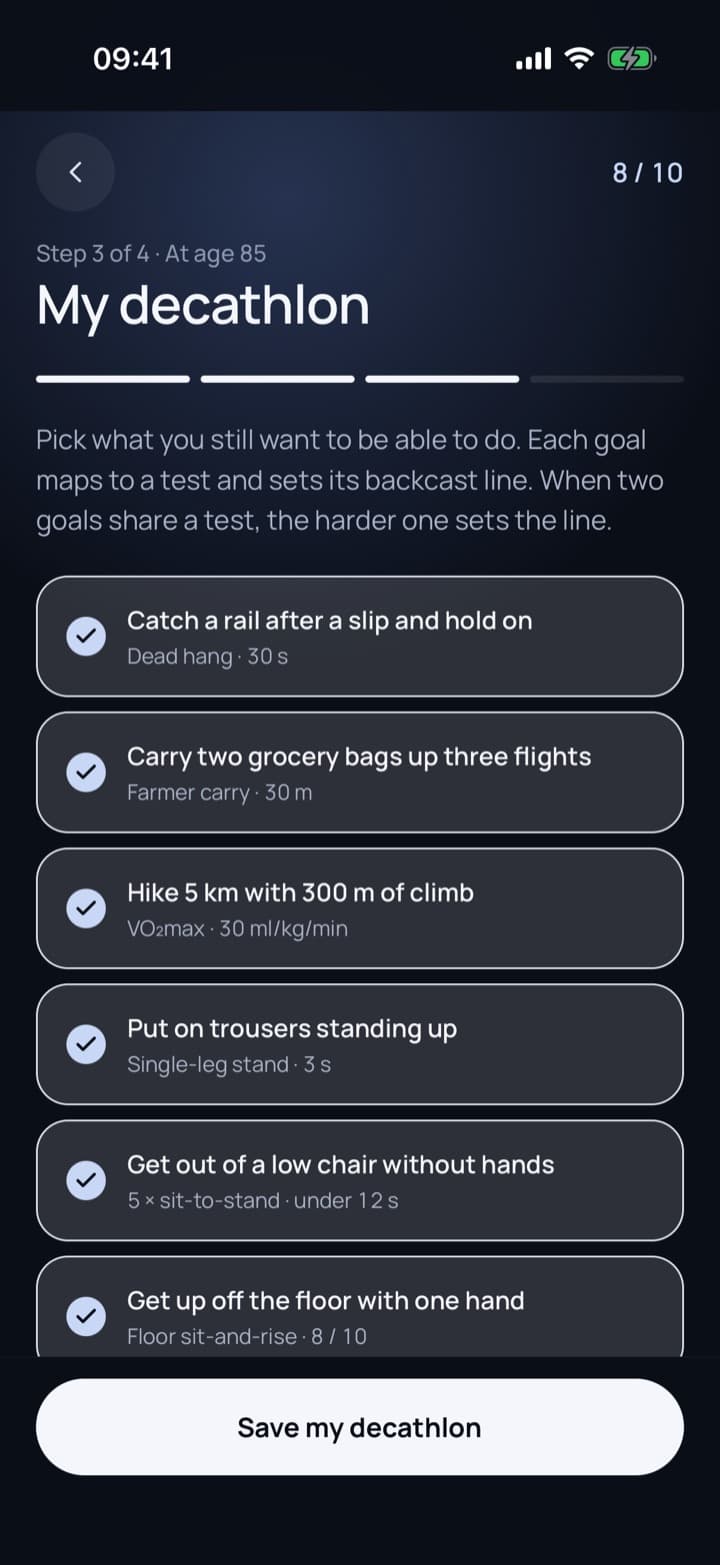
Choose what you want to do at 85.
Sixteen goals, from getting up off the floor with one hand to hiking 5 km with 300 m of climb. Each maps to a test. When two goals share a test, the harder one sets the line.
Take a baseline of ten field tests.
About 40 minutes, and you can spread it over several days. Fixed protocols and built-in timers, so a re-test in three months measures the same thing. The baseline is free.
Re-test every quarter.
Every 13 weeks, with at most three reminders. Each result is read against age and sex norms and against your own line. One glance says which tests are behind and what to do about it.
The line, not the leaderboard
Your goal at 85 sits at some percentile among 85-year-olds. Your line at every earlier age is the value at that same percentile for that age. Stay on it, and you arrive at 85 still able to do the thing.
Decline speeds up late in life, so the margin has to be built early. In the same people over time, VO₂max fell 3–6% per decade in their 20s and over 20% per decade from their 70s.
Every number is read against your own line and published norms. Never against other people.
Goal at 85
Pick up a 15 kg child from a squat: 30 kg grip.
The ten tests
Stability, strength and aerobic capacity. Each one says what its reference is, in words.
Stability
Strength
Inside the app
Dark, calm, one number per screen. Made for a glance between quarters and for sweaty hands mid-session.
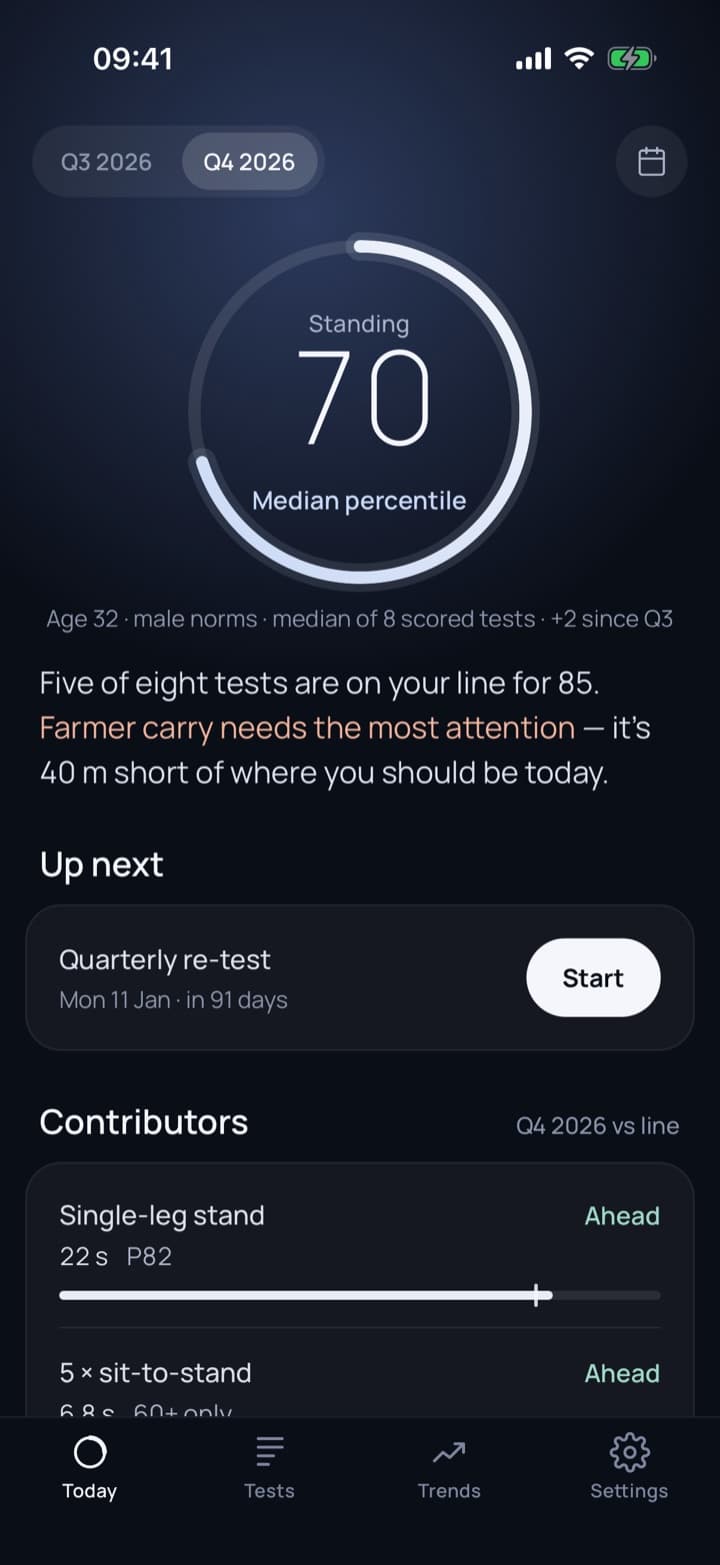
Today
One standing, one sentence, the next re-test.
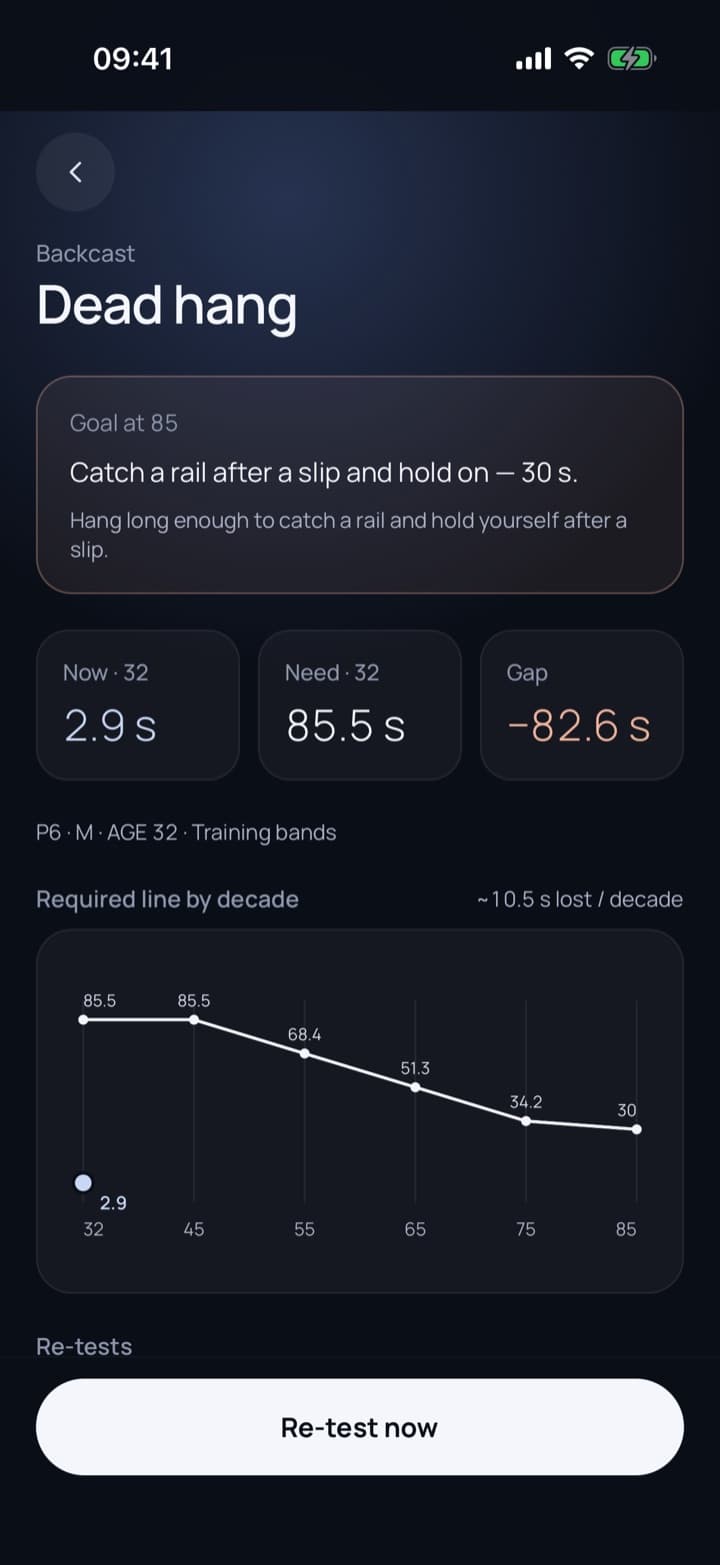
Backcast
Where you need to be at every decade.
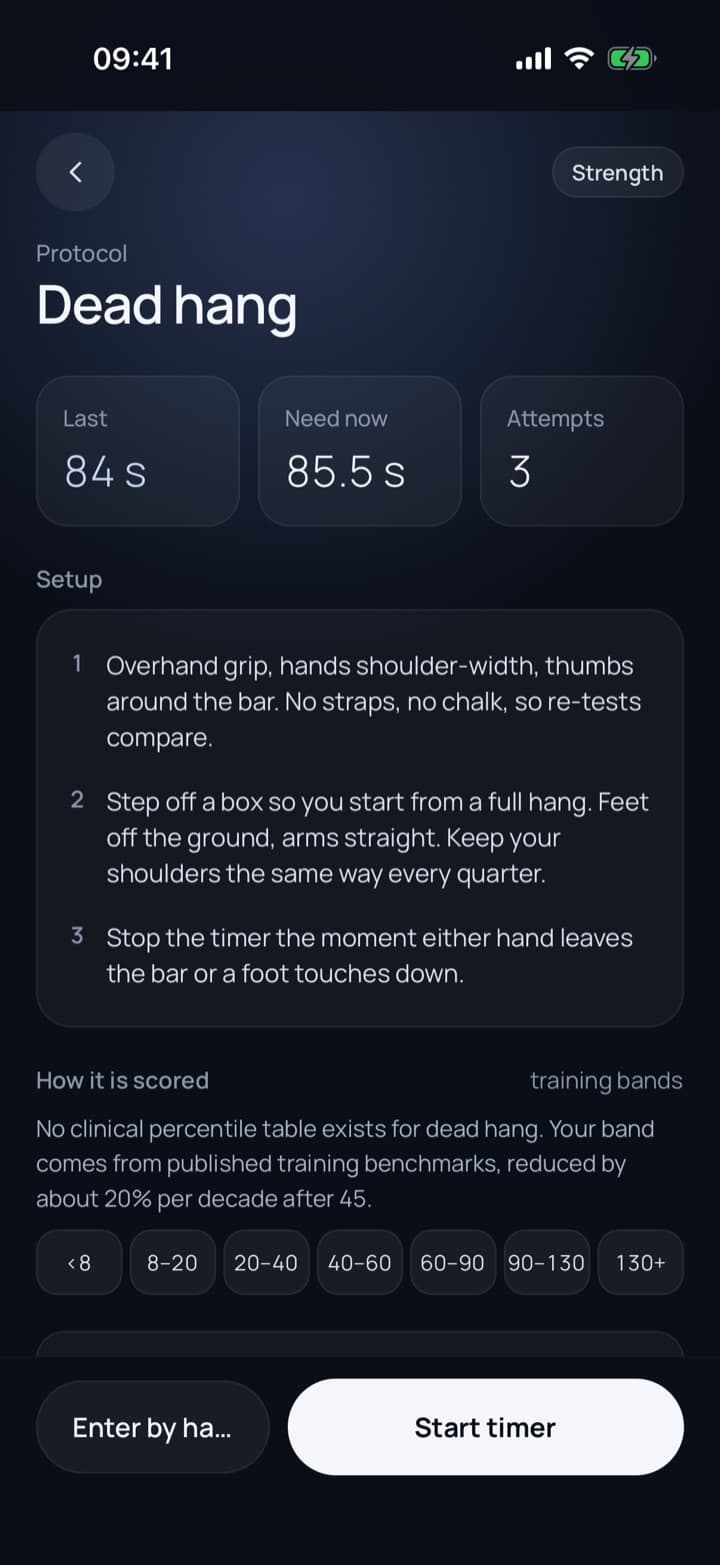
Protocol
The same steps every quarter.
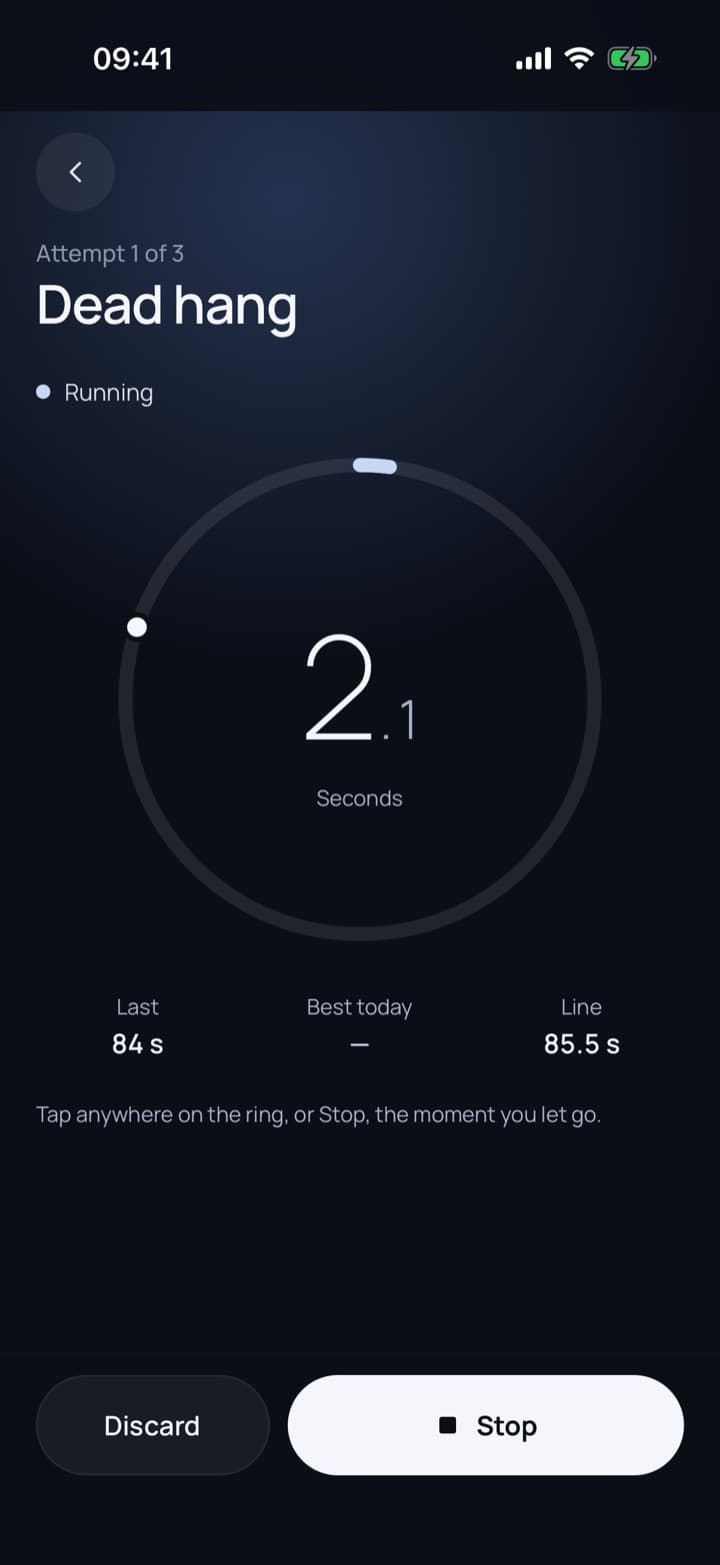
Timer
Tap the ring to stop. Made for sweaty hands.
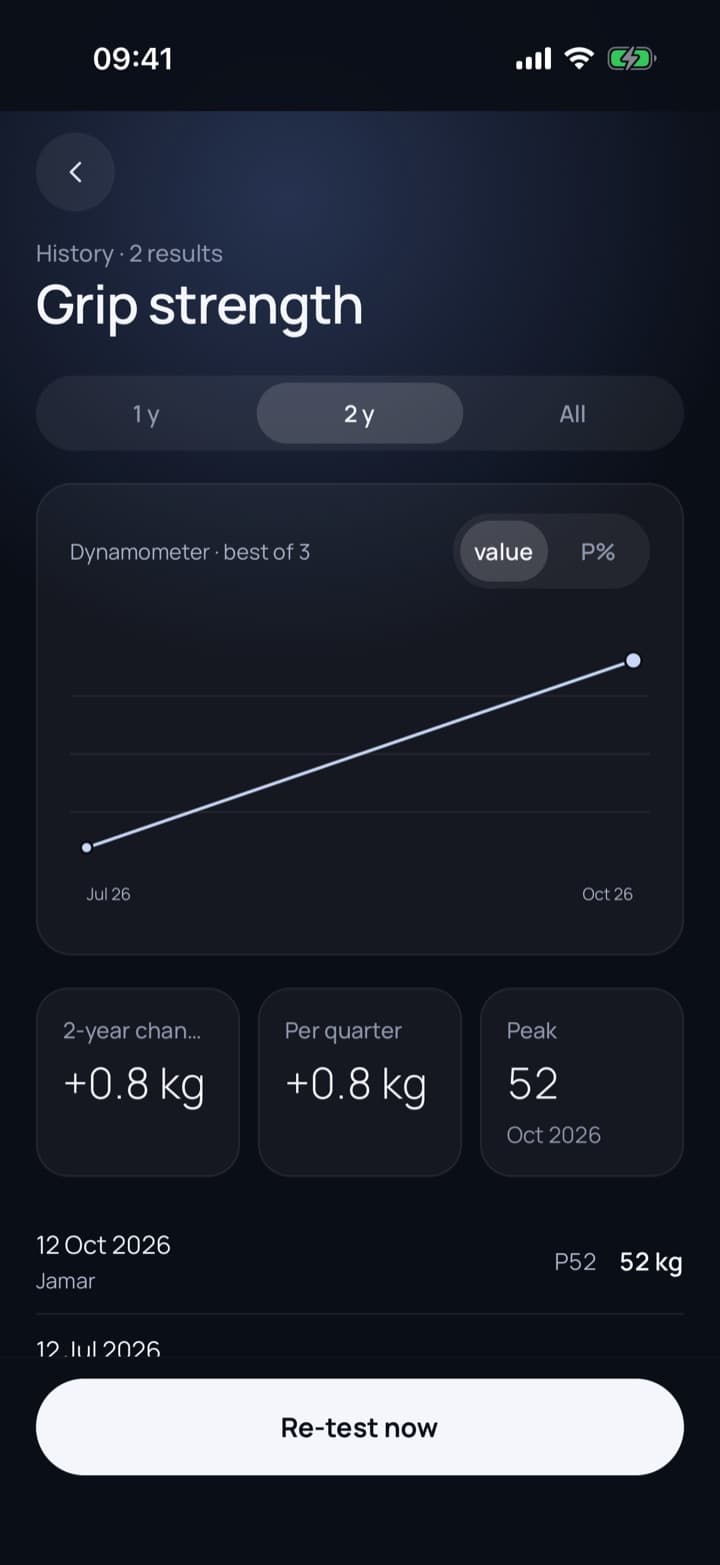
History
Your own trend, not the population curve.
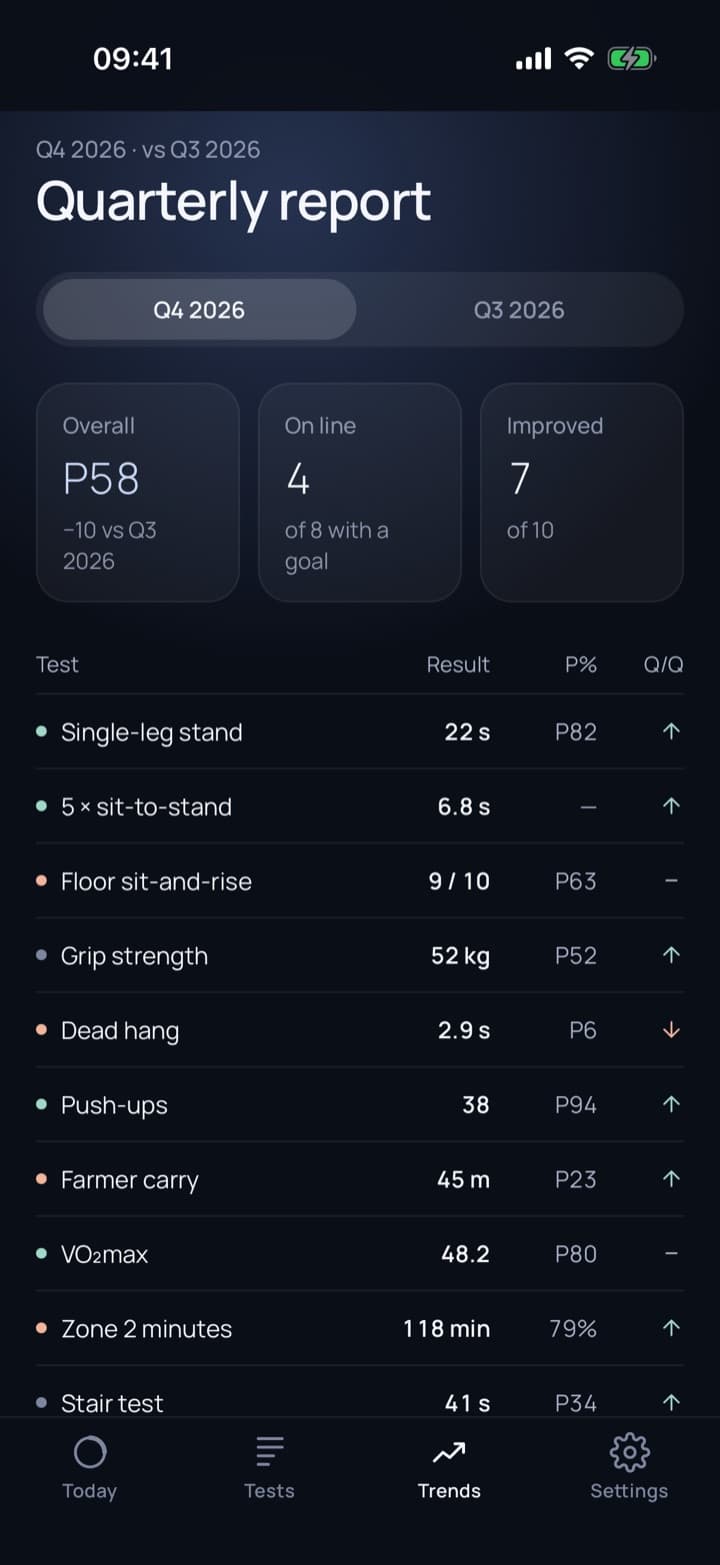
Quarterly report
Every test against last quarter.
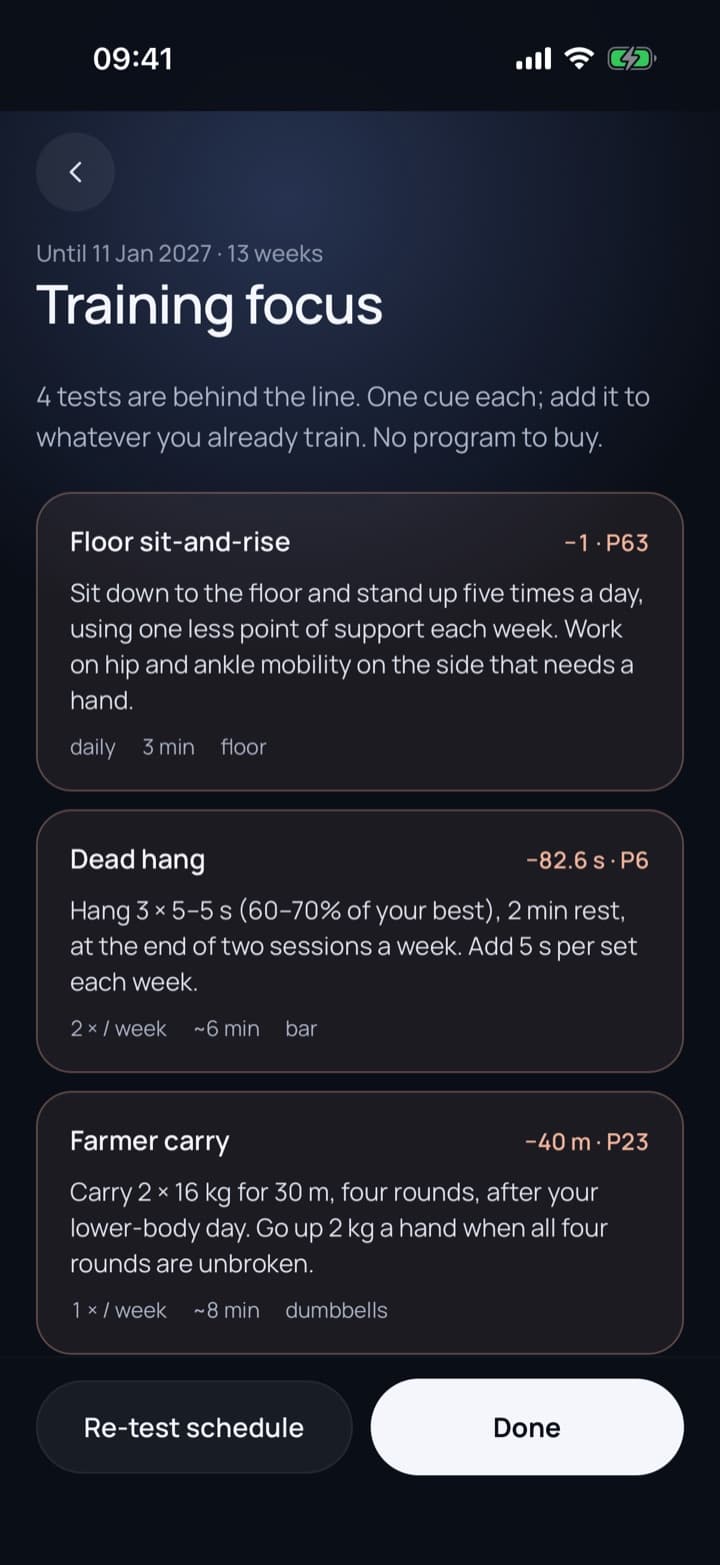
Training focus
One cue per gap. No program to buy.
Honest precision
Every percentile names its source table. Where no clinical table exists, the number says “estimated”. Where the evidence stops, so do we.
Sources on every result
Where the evidence stops
What it does not do
- No camera or pose detection.
- No leaderboard and no social feed.
- No account and no server for your data.
- No streaks, badges or nagging.
- No training program to buy.
Pricing
Your baseline is free. Everything after it is a single unlock. No account, no upsell inside.
Baseline
Free
Onboarding, the full baseline session of ten tests, and a percentile for every result.
Lifetime
$29once
Pay once. Unlimited quarterly re-tests and reminders, the backcast line for every goal, history, quarterly reports, share cards, and CSV export and import.
Yearly
$19a year
The same unlock, renewed each year until you cancel. A year covers four quarterly re-tests.
US prices. The app is not in the stores yet.
Questions
Coming soon to iPhone and Android.
Until then, enter a few results and see your percentiles and your line, using the same engine as the app.